Delphin Guide
DeepSeek vs OpenAI Images 2.0
Compare DeepSeek and OpenAI Images 2.0 the right way, then use a curated set of DeepSeek resources to decide whether you need open research or a managed image API.
Why This Guide Matters
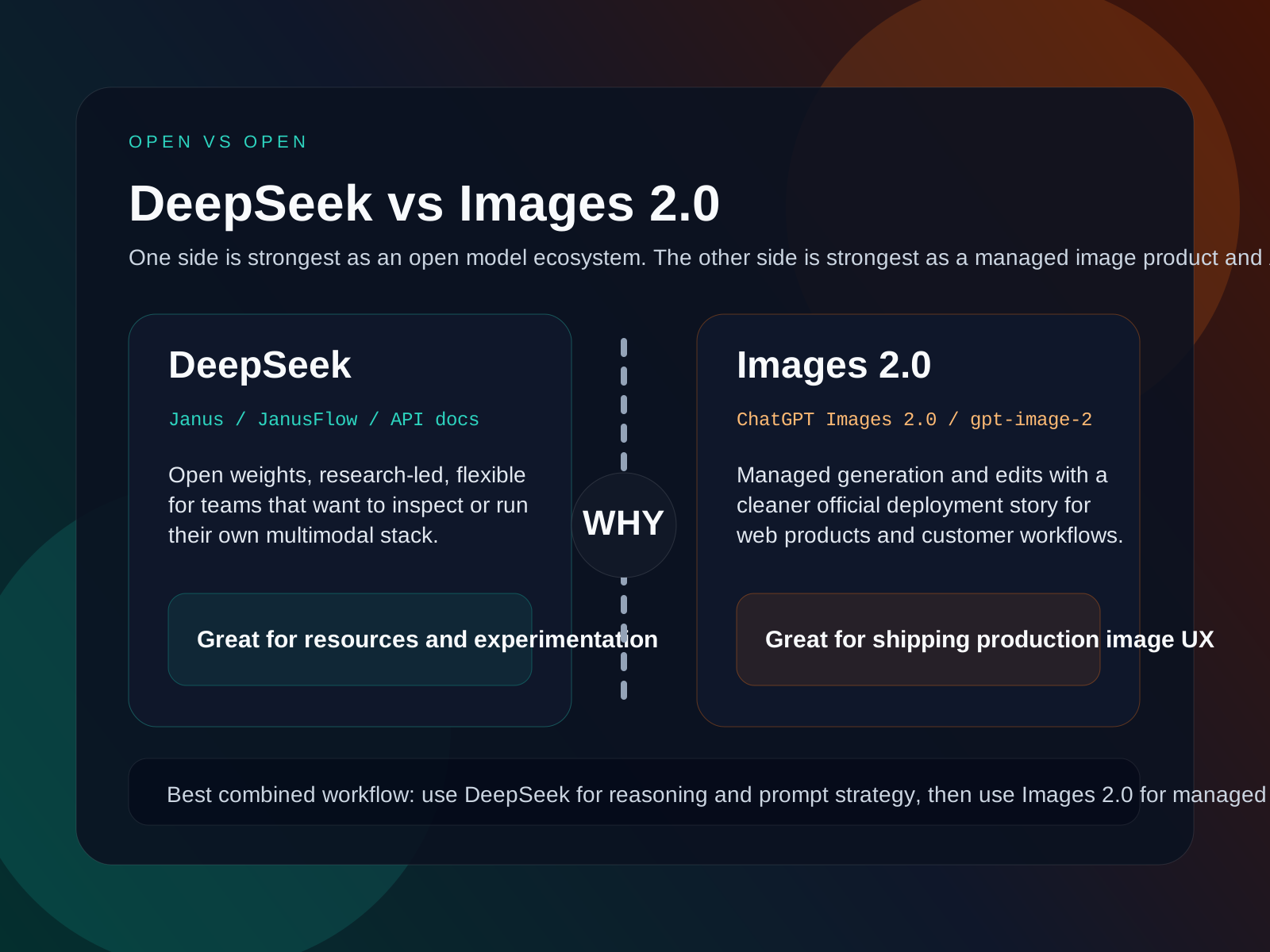
As of April 22, 2026, DeepSeek and OpenAI Images 2.0 are not mirror-image products. DeepSeek's official hosted API is still centered on language and reasoning models, while its image-generation story is more visible in open-source research projects such as Janus and JanusFlow. OpenAI, meanwhile, is offering a more managed image path through ChatGPT Images 2.0 and gpt-image-2.
How To Use This Workflow
1. Decide whether you need an open ecosystem or a managed API
This is the first filter. DeepSeek is more compelling when you want open research and flexibility, while OpenAI is more compelling when you want a production-ready image service.
2. Separate hosted products from research assets
Do not compare a polished API product directly against a research repo without accounting for deployment work, tooling, and operational overhead.
3. Use the best of both where it makes sense
Many teams can use DeepSeek for reasoning, prompt planning, or open experimentation, then use Images 2.0 for the final managed image-generation layer.
These are not direct one-to-one products
If you frame the comparison as DeepSeek versus OpenAI image quality, you risk flattening two very different ecosystems. DeepSeek's official API docs currently emphasize chat and reasoning models. OpenAI's current story, by contrast, clearly includes an official image API surface with generation and edit flows.
That means the real comparison is open research plus flexibility on one side versus managed deployment plus official image workflows on the other. Which one is better depends far more on your engineering and product constraints than on abstract model identity.
- DeepSeek's hosted API story is strongest in language and reasoning.
- DeepSeek's image story is easier to find in official open-source repos such as Janus.
- OpenAI's image story is stronger as a managed product and API today.
- These ecosystems answer different operational needs.
Where DeepSeek is genuinely strong
DeepSeek is especially attractive when you value open assets, inspectability, and the ability to experiment outside a tightly managed vendor boundary. That is why the Janus family matters. It gives technical teams a way to study, adapt, and self-direct parts of the multimodal stack rather than only consume an opaque hosted endpoint.
- Open-source multimodal research assets that technical teams can inspect
- More freedom for self-hosting, experimentation, and architecture learning
- A strong complement for prompt planning, reasoning, and workflow orchestration
- Useful for teams whose priority is capability ownership rather than fastest deployment
Where Images 2.0 is stronger today
Images 2.0 is stronger when the question is not what can be researched, but what can be shipped. If your team needs a website to call an official image API, store jobs, manage credits, edit reference images, and keep the whole system maintainable, OpenAI currently offers the cleaner production story.
- Official generation and edit endpoints with a documented model path
- A more direct fit for SaaS products, creator tools, and internal dashboards
- Less operational work than standing up and maintaining your own image stack
- A better choice when you need speed to market more than research flexibility
DeepSeek resources worth reading
If you are evaluating DeepSeek seriously, do not stop at social posts or reposted benchmark screenshots. Start with the official resources below so you can distinguish hosted API capability from open-source research capability.
For the official hosted API
Use DeepSeek's official API docs first. That is where you can verify what the company is actively exposing as a managed platform rather than what the community assumes it supports.
- DeepSeek API docs
- DeepSeek platform model listings
- Current release notes and pricing pages
For image and multimodal research
Use the official DeepSeek GitHub organization for Janus, Janus-Pro, and JanusFlow-style resources. Those repos are the clearest signal that DeepSeek's image direction is strongest in open multimodal research and experimentation.
- deepseek-ai/Janus
- deepseek-ai/JanusFlow
- Any linked papers, checkpoints, and evaluation notes in those repos
A practical combined workflow
For many teams, the best answer is not either-or. Use DeepSeek where reasoning, planning, and open experimentation help you think better. Use OpenAI Images 2.0 where you need a managed image layer that can plug into a website or production creative tool with less friction.
- Use DeepSeek to plan prompts, style systems, or visual requirements.
- Use Images 2.0 to generate or edit the final production assets.
- Keep the boundary clean so each model family does the work it is best suited for.
FAQ
Does DeepSeek have an official hosted image API like OpenAI Images 2.0?
As of April 22, 2026, DeepSeek's official hosted API is easier to verify for chat and reasoning. Its image-generation story is more visible through official open-source projects such as Janus rather than a directly comparable managed image API surface.
Is DeepSeek still useful if I mainly need image generation?
Yes, especially if you care about open multimodal research, self-hosting paths, or pairing reasoning with image workflows. It is just a different kind of value than a managed image API.
What is the simplest production choice for a website today?
If the goal is a managed, official image API that you can wire into a site quickly, Images 2.0 currently has the clearer path.